








I have a confession: I used to think duochrome nails were just a runway gimmick. Pretty in photos, impractical in real life, something you’d see on an editorial shoot and then never actually pull off on a Tuesday morning. Then I had a slow January, a lot of free time, and an absurdly large stash of chrome powders I’d been ignoring for six months. So I made a deal with myself — thirty days, nothing but shift-color finishes. No classic reds, no safe nudes. Just pure, iridescent chaos.
Week 1: Setting a Baseline
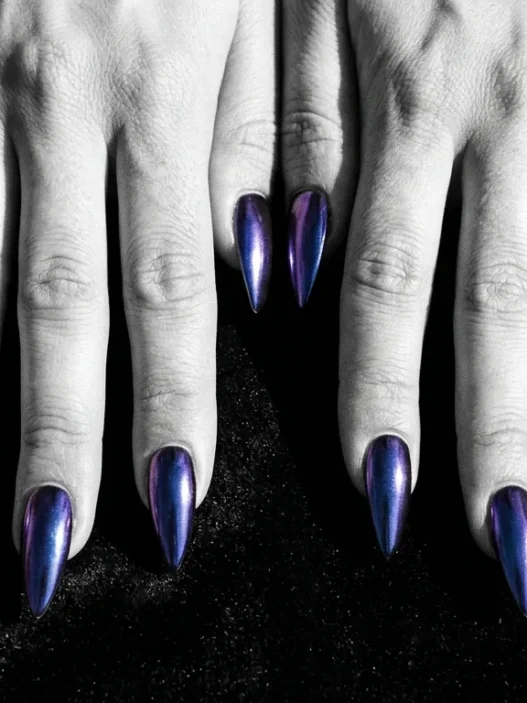
I started with the most accessible version of the look — a gel base in deep navy, topped with a blue-to-violet chrome powder rubbed in with a silicone applicator. Classic. Safe-ish. Something I’d seen all over nail art designs on my Pinterest saves for months without ever attempting it myself.
The application was messier than I expected. The powder migrated to my cuticles on three fingers, and I had to clean up the edges twice before I was happy. But when I held my hand up to the window? That shift. That ridiculous, otherworldly slide from deep ocean blue into a warm purple that only appears at certain angles. I stood there for a genuinely embarrassing amount of time just tilting my fingers back and forth.
Day three, a woman at the coffee shop grabbed my wrist — gently, but still — and asked what gel brand I was using. I had to explain it wasn’t a gel at all. It was a powder applied over gel. She looked skeptical. I get it. The color-shifting effect sounds like marketing fluff until you’re actually watching it happen in person. The wear was solid, too. No chips by day seven, which for me is basically a miracle given how aggressively I type.
Week 2: First Signs of Change
Week two is where things got genuinely interesting — and also where I started to notice some real differences in how I related to my manicure. I switched to a rose-gold-to-green shift for the second set. Sounds chaotic. Absolutely is. And I am here to tell you it works in ways I cannot fully explain.
What I didn’t expect was how much the color changed depending on my outfit. On days I wore cream or white, the rose gold dominated. On days I wore olive or deep green, the shift leaned almost entirely into the green end of the spectrum. My nails were essentially doing their own accessorizing. I started planning outfits around them, which is either very dedicated or slightly unhinged — probably both.
I also started paying closer attention to application technique. A few things I figured out by day ten:
- Rubbing in one direction gives a cleaner, more mirror-like finish than circular buffing
- A matte top coat activates the shift more intensely than glossy (counterintuitive but true)
- Thinner gel bases reflect more depth — thick coats muddy the effect
- Natural light is your best friend; fluorescent office lighting is your worst enemy
- Squoval nail shapes catch the shift at more angles than very round nails — if you’re into square squoval nails, this is genuinely the best shape for showing off duochrome
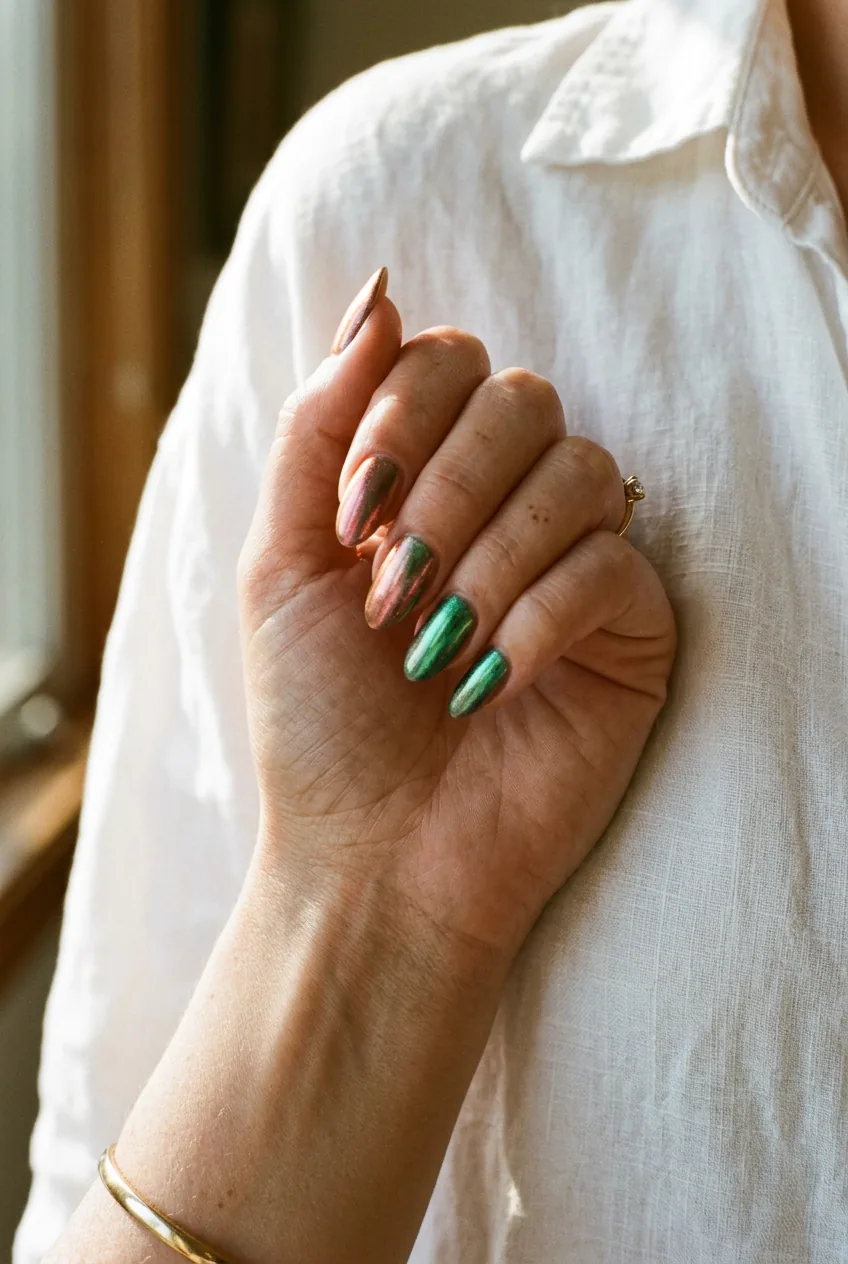
My friend Sara saw this set and immediately booked herself a salon appointment specifically asking for “the color that changes.” The technician knew exactly what she meant. That alone told me this finish had moved well past niche into mainstream-but-still-feels-special territory.
Week 3: The Unexpected Shift
Okay. Week three was not what I planned, and it’s the part of this experiment that genuinely surprised me.
I went with a warm copper-to-teal duochrome — the kind that reads almost bronze in dim light and then goes full peacock in sunlight. It’s the most summer nails energy I’ve ever had on my hands in the middle of winter, and honestly? It lifted my mood in a way I didn’t anticipate.
Here’s the unexpected part: I stopped reaching for rings. I have a pretty solid jewelry habit — stacking rings, always, minimum three. But with this nail set, every time I put rings on, they competed with the nails. The nails WON. Every time. I found myself going bare-handed except for one simple gold band, and I actually liked it. The nails were the statement. Everything else became noise.

This is where I’ll share my probably-controversial opinion: I think duochrome nails have made a lot of traditional nail art redundant for me. I used to love intricate florals and geometric patterns. I still appreciate them. But the optical complexity of a well-done color-shift finish does something that painted art can’t — it changes. It moves. It’s different in the elevator than it is at your desk than it is at dinner. No painted design does that. And honestly, I’d rather have one extraordinary living color than ten minutes of painstakingly placed nail art that looks the same in every light forever.
Some people will find that take annoying. That’s fine. Come look at my nails in the sunshine and then tell me I’m wrong.
Week 4: Final Verdict
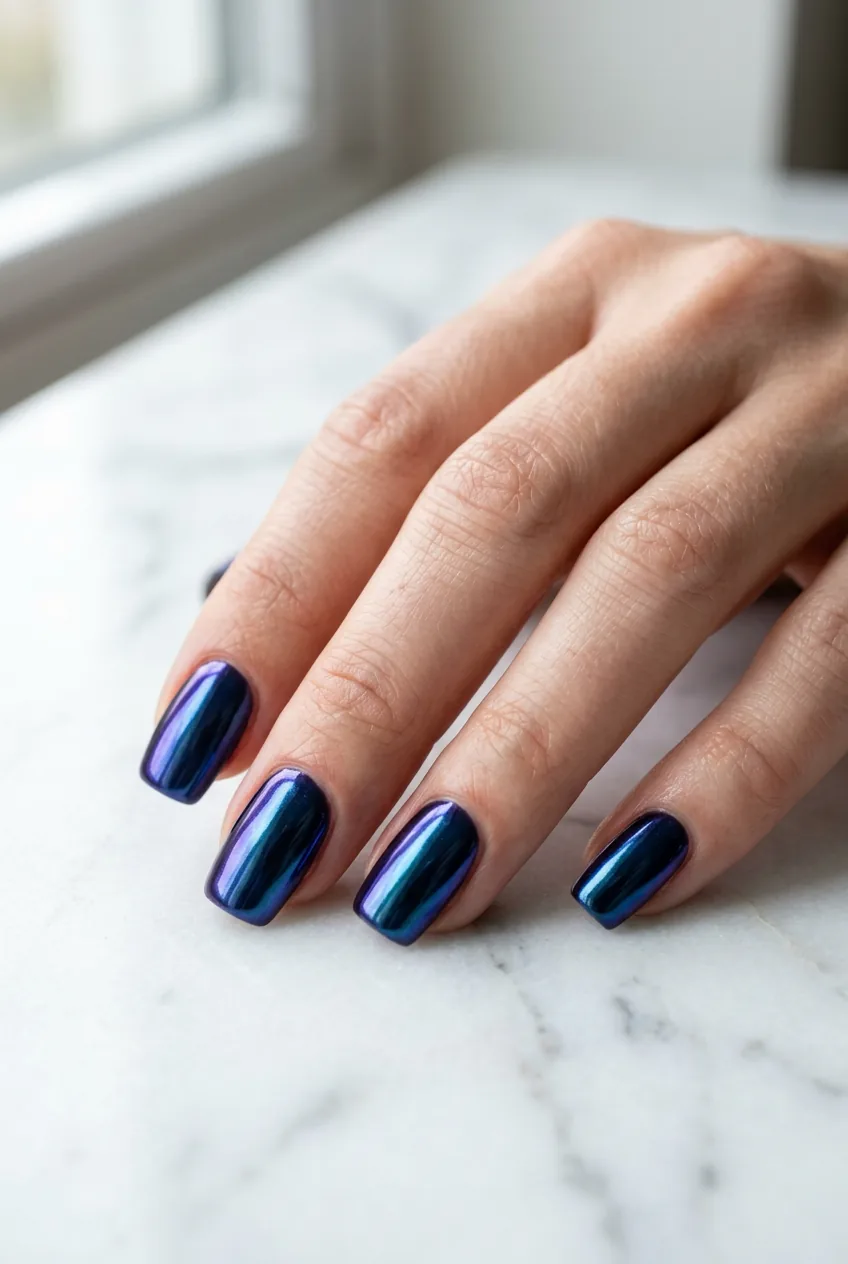
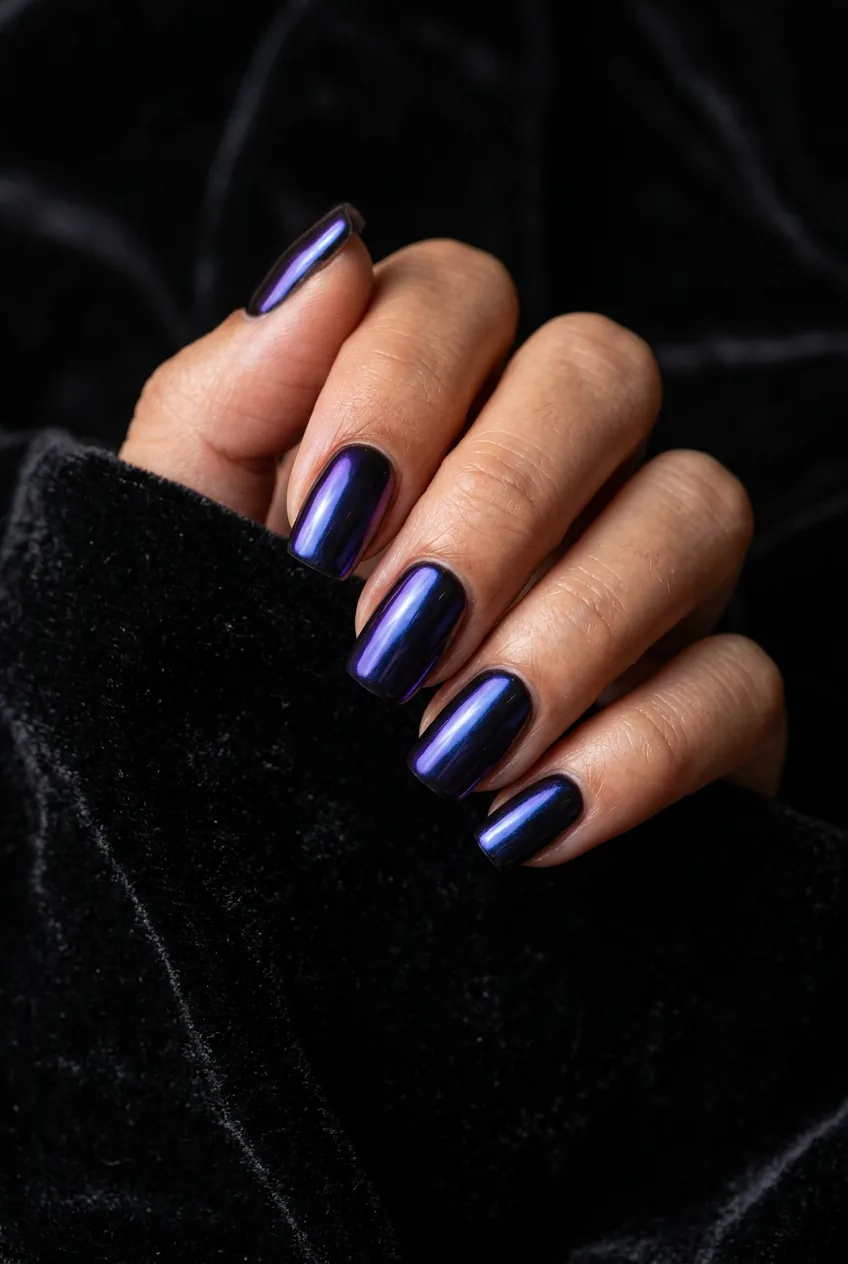
For the final week I went back to where I started — blue-violet — but this time with a slightly different base. Instead of navy I used a soft black jelly gel, which gave the chrome powder a darker, more mysterious foundation. The shift was less neon, more grown-up. Honestly my favorite set of the entire month.
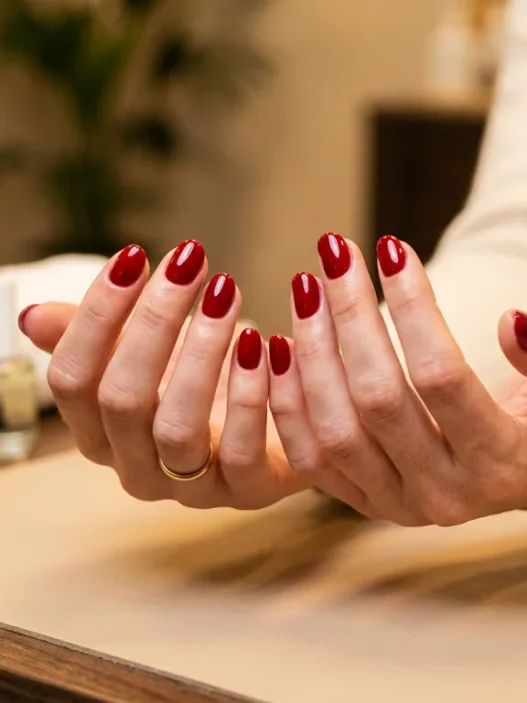
Look at the photo below — she’s wearing almost the exact same color family, and notice how the black base makes the violet pop differently than it would over navy. That depth is everything. The color doesn’t just shift horizontally from one hue to another; it also shifts in intensity depending on what’s underneath it.
After 30 days, here’s what I know for certain:
Duochrome finishes aren’t a trend that’ll fade by next season. They’re a technique — and once you understand how they work, they become a permanent part of your rotation. Every season offers a new color combination worth trying.
They work in every season. I’ve already been thinking about a burgundy-to-gold shift for fall nails, and a frosty silver-to-lavender for winter nails. The palette possibilities genuinely feel endless. I didn’t get bored once in thirty days — and I get bored with most manicures by day five.
The Products That Actually Delivered
I tested seven different chrome powders and two different application methods over the month. Not everything performed equally. Here’s the honest breakdown of what I kept reaching for versus what got quietly retired to the back of my drawer.
The powders that gave the most intense shift were consistently the ones with a finer particle size — almost silky to the touch, not gritty. If a powder feels rough between your fingers before application, the finish will look grainy on the nail. It’s that simple. I learned to check texture before I bought, and you can read more about chrome powder application to understand exactly why particle size matters so much for clarity.
I also found that the brand of gel base mattered more than I expected. Soak-off gels cured to a “sticky” layer gave better powder adhesion than hard gels cured to a non-tacky finish. A few of the powders barely showed up on hard gel — same powder, completely different result. Frustrating to discover on your own, incredibly obvious once you know.
For top coats, I alternated between matte and glossy throughout the experiment. My conclusion: matte top coats are dramatic and editorial (that intense depth is unreal), but they chip faster at the edges. Glossy top coats are more practical for everyday wear and actually let more light bounce through the chrome layer. For workdays, glossy. For going out, matte. Easy rule.
One more thing worth mentioning — if you want to understand the actual science behind why these pigments shift color the way they do, looking into how duochrome pigments work is genuinely fascinating. It’s all about thin-film interference, the same optical phenomenon you see in soap bubbles and butterfly wings. Once I understood that, I started thinking about application completely differently — angle of light, thickness of the pigment layer, all of it started making more intuitive sense.
And if you’re just starting out and feel overwhelmed by all the terminology, honestly — just read up on nail pigment powders for beginners and start with one powder in a forgiving color family (blue-violet is the easiest to make look intentional). You’ll get the hang of the application within one or two sets, I promise.
A Tutorial That Clicked for Me
Questions I Get About This
Do duochrome nails work on short nails?
Yes, absolutely — and honestly the color shift can make short nails look more dramatic and intentional than almost any other finish. The key is keeping the shape clean and the cuticle area tidy so the chrome reads clearly. Short rounded nails with a warm copper-to-green shift look incredible. Don’t let length stop you.
Can I do this at home, or do I need a nail tech?
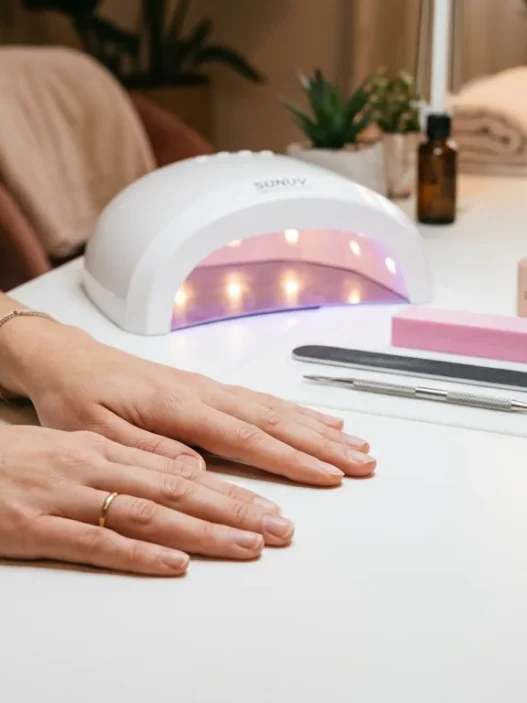
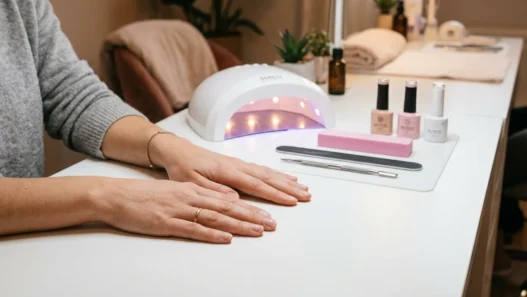
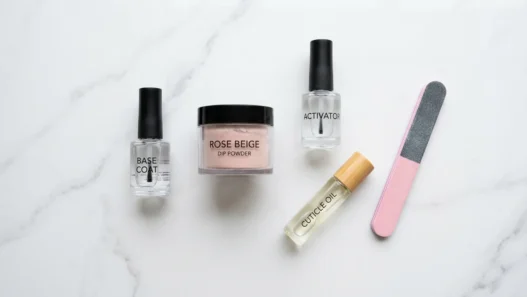
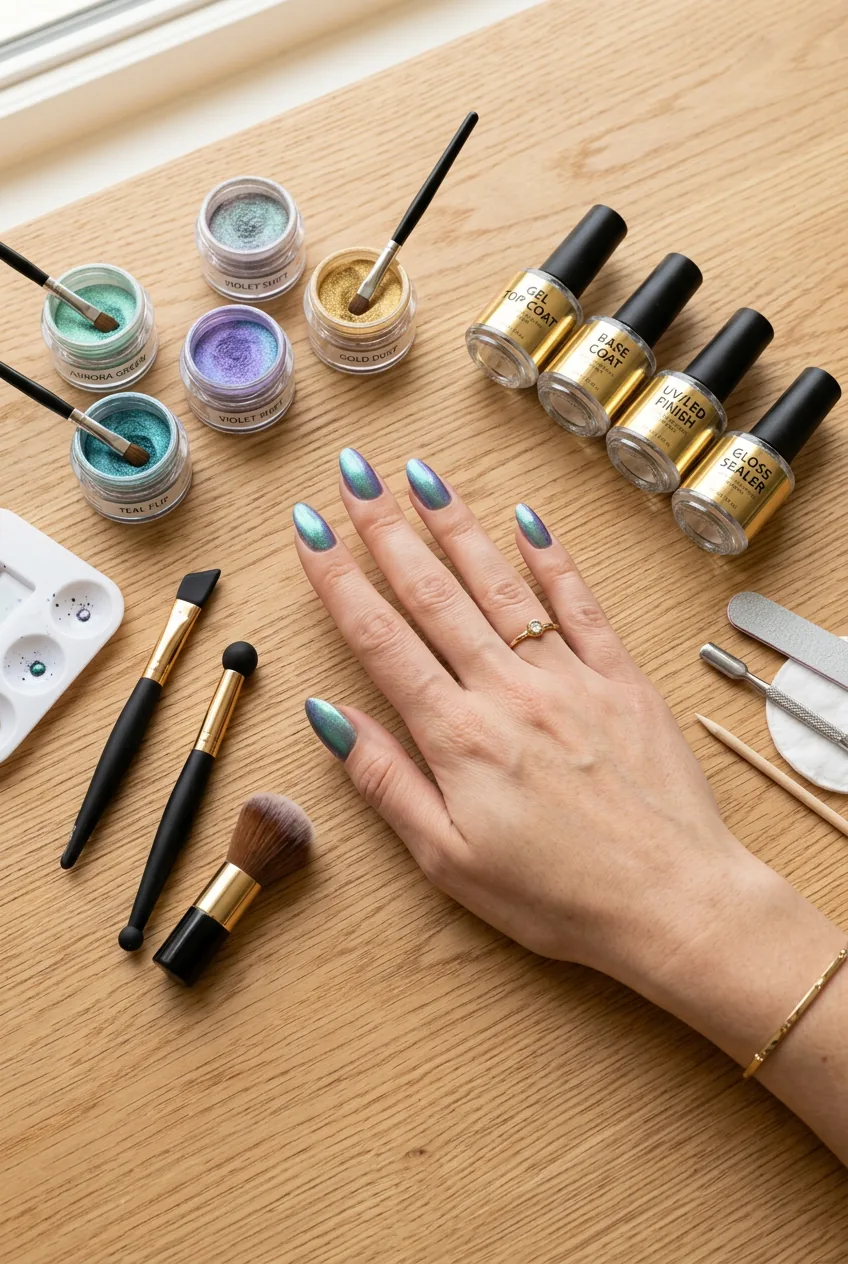
You can absolutely do this at home if you’re comfortable with gel application. You need a UV or LED lamp, a gel base, a chrome powder, a silicone applicator, and a no-wipe top coat. The learning curve is real but short — most people get a decent result by their second attempt. The first try is always a little chaotic, and that’s completely normal.
How long does duochrome powder last compared to regular gel polish?
In my experience, it lasts just as long — typically two to three weeks before I see any tip wear. The chrome layer itself doesn’t chip separately from the gel; it’s sealed under the top coat. Where I’ve seen issues is when the top coat lifts at the edges, which exposes the powder layer. A good prep and a thin flood of top coat along the free edge makes a big difference.
Is there a difference between duochrome nail polish and chrome powder?
Yes, and it’s significant. Duochrome nail polish contains the shift pigment in a traditional polish formula — easier to apply, no lamp required, but the shift is less intense and the finish isn’t as mirror-like. Chrome powder applied over gel gives a far more dramatic, reflective result. Both are beautiful; it just depends on how much effort you want to put in and how intense you want the effect.
What nail shapes show off the color shift best?
Longer, flatter shapes like coffin, square, and squoval give the chrome powder more surface area to catch light at multiple angles simultaneously, which makes the shift more visible. Almond shapes are also gorgeous — the curved tip creates a gentle gradient of the shift that looks almost three-dimensional. Very short or very round nails work fine but show a smaller range of the effect.
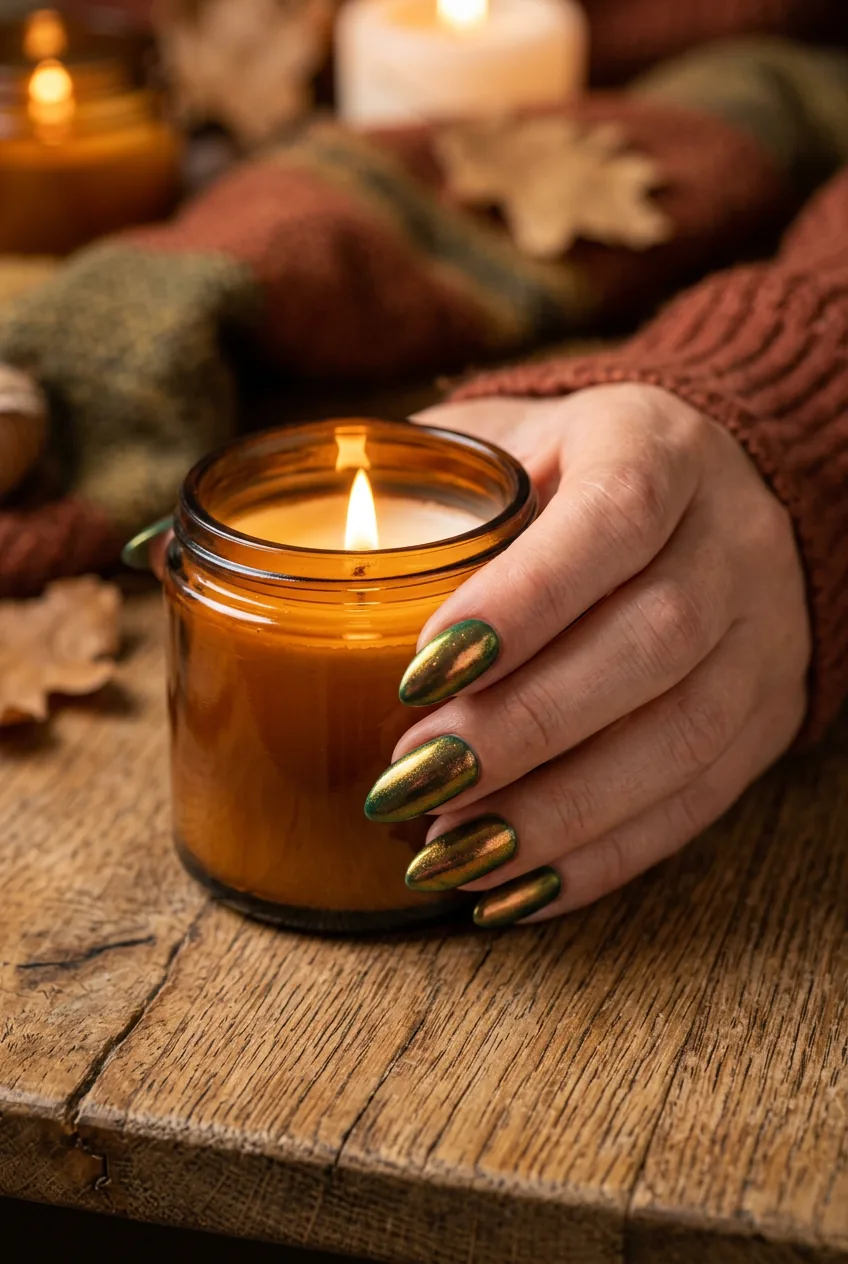
Thirty days went faster than I expected, and I genuinely didn’t want to stop. I’m already on my second week of a new set — a deep forest green with a gold-to-bronze shift that makes my hands look like I’ve been wearing them near an open flame. In the best possible way. If you’ve been on the fence about duochrome nails, take this as your very specific nudge to just pick up one powder and try it. Start with blue-violet. Thank me later.